
A Palm Beach County Previous Residents Timeline
The useful sources overlap rather than form one perfect directory. Start with the source closest to the date you want, then use a deed, legal description, or census household to connect it to the same Palm Beach County property.
| Source | Years It Covers | Where Held | What It Shows |
|---|---|---|---|
| Clerk Official Records | 1909 to present; images from 1968 | Landmark and Records Service Center | Deeds, parties, legal descriptions, recording dates |
| R. L. Polk directories | Selected verified volumes, 1916 through 1980-81 | Main Library | Adult names, street addresses, work and spouse clues |
| Federal census | Public through 1950 | Library genealogy databases and federal archives | Household members and relationships |
| Sanborn maps | Palm Beach 1919; West Palm Beach 1920 | Library of Congress | Building footprint, use, lots and old numbering |
| Palm Beach Post archive | 1916 to today | County library remote or branch access | Obituaries, notices and address context |
For a recent transfer, begin with PAPA and Landmark. For a mid-century household, begin with the nearest verified Polk volume and compare it with a public census year. For an early building, the Sanborn sheet and old plat may explain why the present address does not appear.
Start a Palm Beach County Previous Residents Trail in PAPA
Palm Beach County Property Appraiser Public Access, or PAPA, is the cleanest first stop because it joins the current situs address to the owner, mailing address, 17-digit parcel control number, legal description, sales, deed links, improvements, and map. Save those fields before searching for previous residents. The situs is the physical property; the mailing address is where the owner receives notices. Neither field, even with a homestead exemption, lists every occupant.
Type an owner name, address, or PCN into Real Property Search. The address control uses predictive suggestions, so entering it slowly and selecting a result can work better than pasting a full line. On the parcel page, copy the exact legal description and each sale book/page or instrument reference. These stable identifiers guard against false matches when owners share a name or an address has changed.
Open a Deed for Palm Beach County Previous Residents
The Landmark Web Official Records Search offers Name, Book/Page, Instrument Number, Parcel ID, Legal, Advanced Legal, Record Date, and other modes. A PAPA sale link may lead straight to the recorded instrument. Otherwise search the book and page or Clerk File Number copied from the parcel record.
The index should identify the parties and their roles, document type, recording date, instrument or book/page, and any indexed legal description or PCN. Read the image when it is available. The deed itself may show the grantor, grantee, return address, consideration, witnesses, notary, and full legal description. It proves a title event, not who slept at the property on that date.
Walk the Palm Beach County Previous Residents Deed Chain
A deed chain links each purchase to the one before it. Work backward from a verified current deed, and check the legal description at every turn rather than assuming a matching surname points to the same land.
- Copy the current owner, PCN, situs, and legal description from PAPA.
- Find that owner's purchase deed and note its grantor, date, and instrument reference.
- Search the grantor as an earlier grantee, narrowing by date and the same land description.
- Repeat through the online images, which begin January 1, 1968.
- For 1909 through 1967, request books, film, or a paid year-by-year Clerk search.
- Grantor / grantee
- The grantor transfers an interest; the grantee receives it.
- Chain of title
- The linked sequence of recorded transfers for the same land.
- Legal description
- The formal land identifier, often lot, block, subdivision, section, township, and range, that survives a street-address change.
When Palm Beach County Previous Residents Predate Online Images
Official Records books begin with Palm Beach County's creation in 1909, but online document images begin in 1968. The Clerk's Records Service Center at 205 N. Dixie Highway, Room 4.2500, West Palm Beach, supplies older books and film. A Clerk search costs $2 per year per name or legal description. Mail requests go to P.O. Box 4526, West Palm Beach, FL 33402-4526 and should state the exact name, time span, requester contact details, and include a self-addressed stamped envelope and fees.
Before July 1909, search predecessor Dade County records. Early Palm Beach County books can also cover land later assigned to Broward, Okeechobee, or Martin counties. That jurisdiction shift is more important than a myth about a local courthouse fire: the reviewed official sources document no wholesale fire loss.
Match Palm Beach County Previous Residents to Census Years
Selected R. L. Polk volumes verified at the Main Library include 1916, 1920, 1925, 1930-31, 1935, 1940, 1944, 1950, 1955, 1960, 1965, 1970, 1975, and 1980-81. They are snapshots, not a proven complete run. The address or reverse section can name an adult at a house, while alphabetical entries may add a spouse, occupation, employer, or notation.
- Find the address in the closest verified Polk volume and transcribe the entry exactly.
- Compare the next available volume for changed names, spelling, or numbering.
- Pair 1920, 1930, 1940, or 1950 directory evidence with the matching public census household.
- Use the deed chain to distinguish an owner from a renter or other occupant.
- Close a disappearance with an obituary, probate index, or vital-record clue.
The Palm Beach County Directory Book guide explains the collections themselves. Here, the point is to use each volume as one dated layer in the story of a single address.
Sanborn Maps Preserve Palm Beach County Previous Residents Clues
The Library of Congress provides a nine-sheet Palm Beach Sanborn set from December 1919 and a 20-sheet West Palm Beach set from February 1920. These fire-insurance maps can show building form, materials, height or use, doors and windows, lot lines, street width, names, and historic numbering. They do not identify every resident, but they can prove that the building or number existed when a directory placed someone there.
Compare a Sanborn lot with the recorded plat and modern parcel shape. If a search fails under today's street line, try the old name or number seen on the map, then confirm the bridge with the legal description.
Permits Date Palm Beach County Previous Residents Changes
Permits and code files may date an addition, demolition, repair, or change of use that explains a gap in the past-resident trail. County Planning, Zoning and Building serves unincorporated parcels; one of the county's 39 municipalities normally keeps its own files. Check the parcel's actual jurisdiction instead of trusting its postal city.
County searches use address and PCN. Public ePZB offers uncertified status information, while certified open-permit and fine or lien searches have separate fees and processing. For a municipal example, West Palm Beach Civic Access can search permits, plans, inspections, code cases, requests, and projects by keyword or address without login.
A New Palm Beach Post Archive Extends the Trail
The county library launched remote access to the Palm Beach Post Historical Archive on June 17, 2026. It spans 1916 to today and supports keyword, date, and topic searches plus full-page and article browsing with a valid library card. An address search can surface sale notices, social notes, obituaries, or events tied to previous residents.
The library genealogy service is also a practical fallback. Ancestry Library Edition is branch-only, while HeritageQuest is remote with a card. The Main Library is at 3650 Summit Boulevard in West Palm Beach, and its genealogy request form lets staff evaluate a focused name, date, or address question.
A screenshot from the library's archive announcement shows the search resource now available to cardholders.
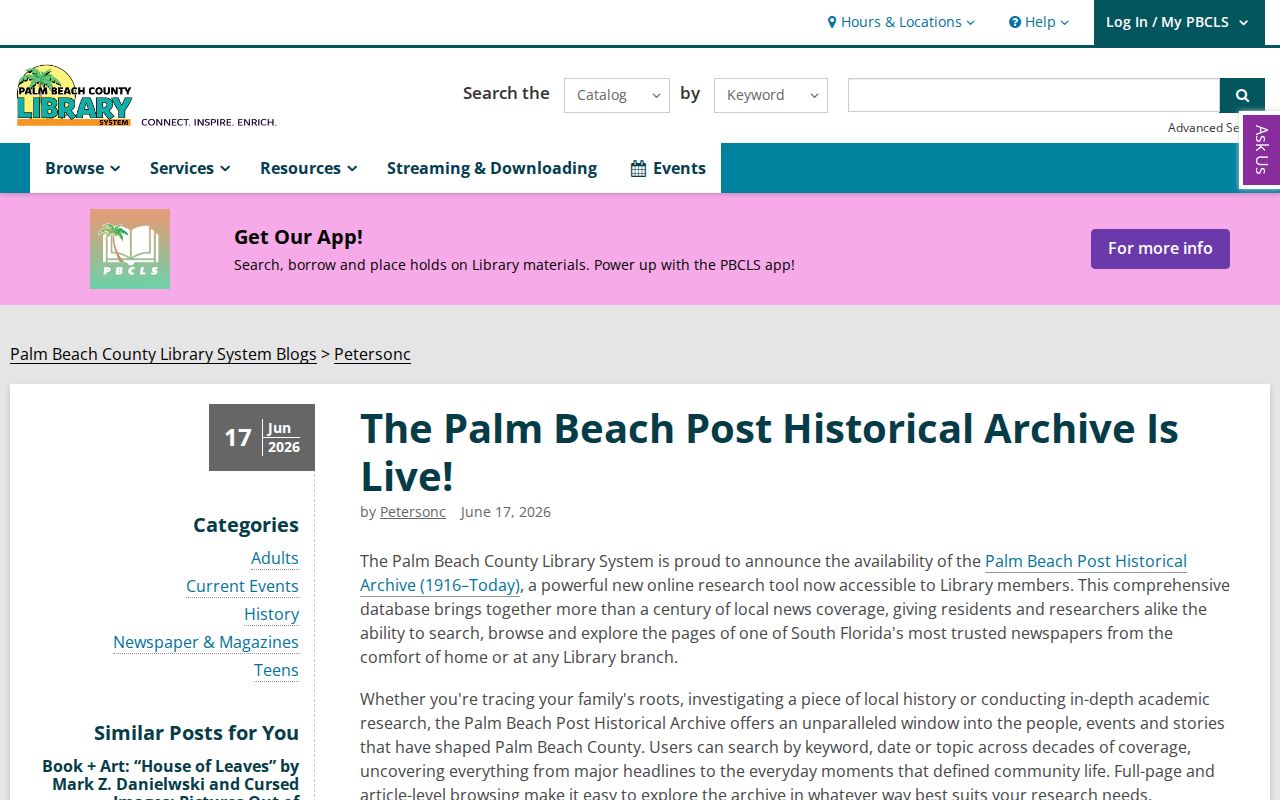
The archive adds newspaper context, but a deed or directory should still anchor an address conclusion.
Previous Residents Beyond Palm Beach County Owner Rolls
Owners are only half the story. A criss-cross directory may identify adults at the address, and a census can reveal relationships and other household members. A deed can show that an owner transferred the property, yet it cannot establish the exact day every occupant arrived or left. Label each conclusion as ownership evidence, occupancy evidence, or a clue.
For an apparent death or estate transition, search Palm Beach Post obituaries and the Clerk's probate index. FamilySearch catalogs a Palm Beach County general estate index for 1909 through 1962, though login or center limits may apply. Death certificates without cause have broader access than cause-of-death copies, which remain restricted for 50 years under Florida law.
Lawful use. Research previous residents for house history, genealogy, or personal curiosity. Florida law prohibits stalking and harassment, so never use an address trail to track or intimidate a living person.